creative notes
Music, Art, and the Room Around A Thought
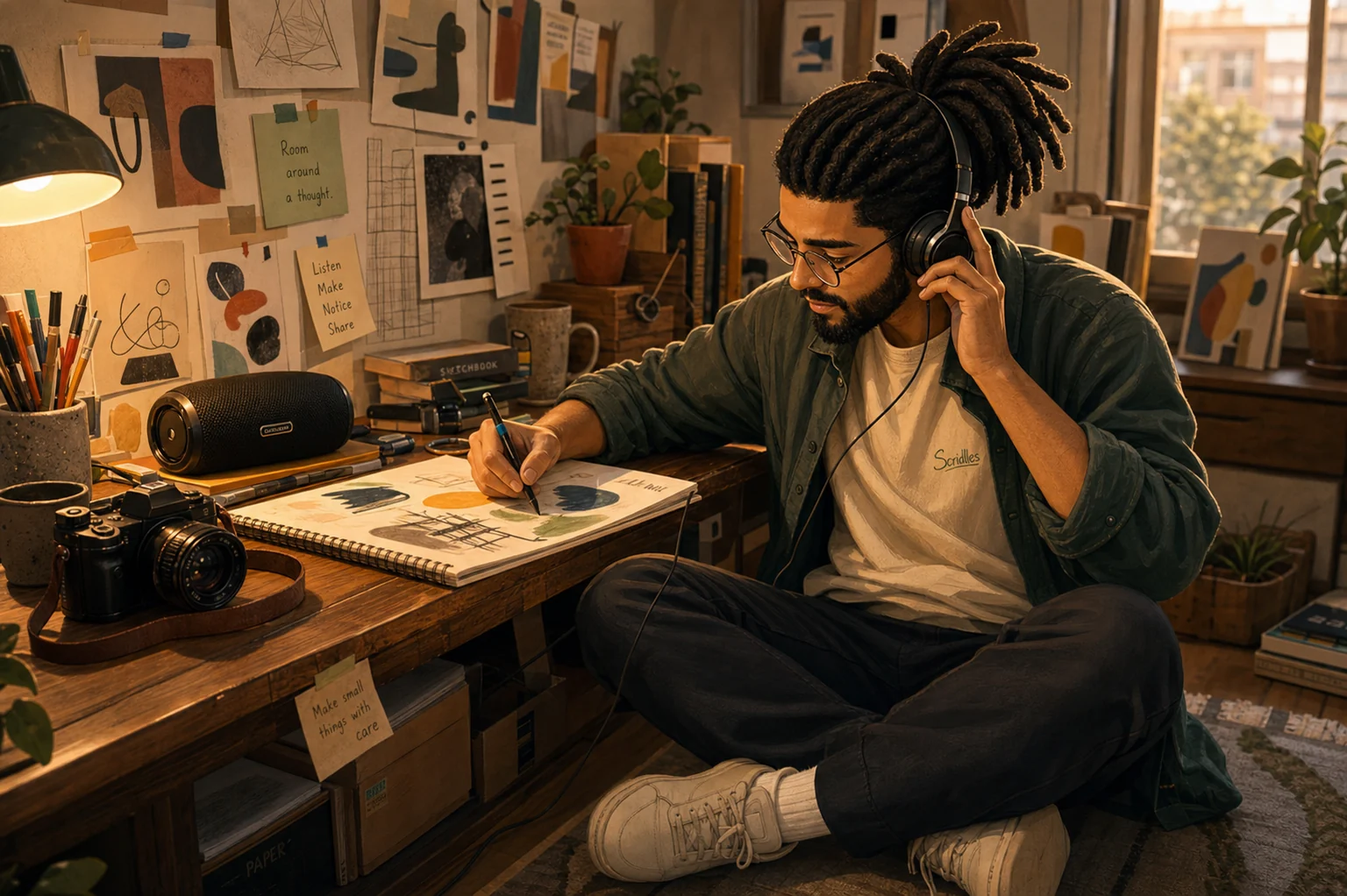
Some thoughts need a room before they can become clear. Music and art help me build that room.

Atmosphere Is Not Decoration
A playlist can change the door into a task. A color can reveal a feeling before I can name it. A sketch can hold the shape of something I am not ready to explain.
This is why music and art belong in Scridles. They are not side hobbies; they are ways of making thought reachable.
The Room Around The Work
Sometimes I do not need a new system. I need the right sound, light, texture, and visual pressure. Too much silence makes a thought loud. Too much noise makes it vanish. The room matters.
The creative practice is learning which room a thought needs.
What I Want To Make
I want to keep more fragments: playlists that helped me start, color combinations that explained a mood, unfinished sketches, photos, and sounds that made the day feel possible.
Not every fragment becomes a finished work. Some fragments are useful because they tell the truth early.
The Room Around A Thought
Some thoughts need a room before they need a conclusion. Music changes the air around the idea. Art changes the angle. A color, a loop, a sketch, a line, or a half-finished visual can make a thought less abstract and easier to stay with. That is not decoration; it is a way of thinking.
When the room around a thought is wrong, I feel it. The idea becomes too sharp, too flat, too noisy, or too hard to approach. When the room is right, I can circle the thought without forcing it to explain itself too early.
This is why creative notes belong beside practical systems. A system helps me return. A creative atmosphere helps me listen. Both protect attention, but they do it through different doors.
Keeping The Fragment Alive
A fragment is fragile at the beginning. If I judge it too quickly, it shuts down. If I ignore it, it disappears. Music and art help me keep the fragment alive long enough to see whether it has more to say. Sometimes that means a playlist. Sometimes it means a sketch, a photo, or a messy paragraph.
I do not want every fragment to become a finished project. I want a place where fragments can be handled with respect. The unfinished thing might be a clue about mood, memory, taste, faith, or the kind of work I am secretly wanting to make.
A good Scridles creative note should preserve that early signal. What did the sound change? What did the image reveal? What became easier to say after the room around the thought shifted?
The Atmosphere Is Part Of The Draft
I used to think of atmosphere as something around the work. More often, it is part of the draft. The sound I choose, the image near the desk, the color in a sketch, or the rhythm of a loop can decide whether a thought opens, hardens, or stays hidden.
That does not mean I need to aestheticize everything. It means I should respect the conditions that let a thought become reachable. Some ideas need quiet. Some need movement. Some need a song that carries the first awkward paragraph until language catches up.
A creative note should record the condition that helped. If a track, image, or room arrangement made the idea easier to approach, that is useful knowledge, not a decorative footnote.
Notes to keep
- Treat atmosphere as support.
- Keep unfinished creative fragments.
- Let art notice before language explains.